
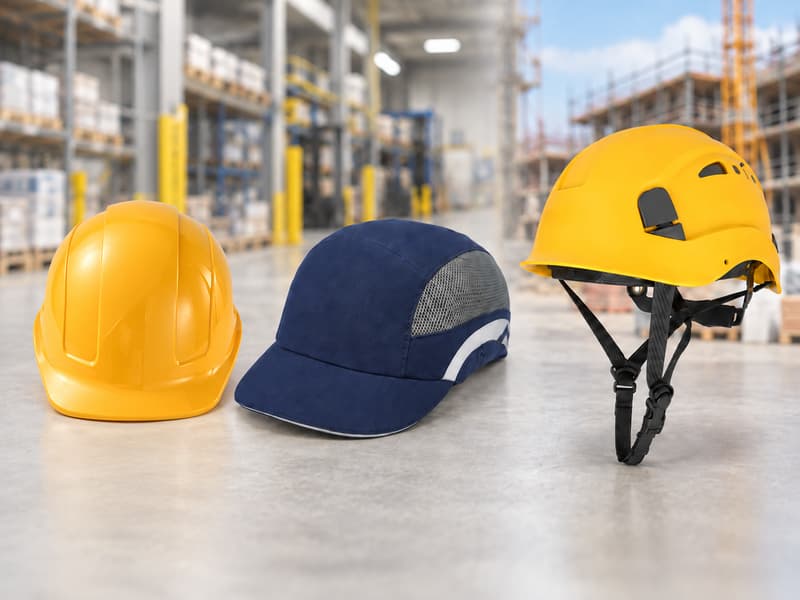
Choosing head protection is not simply a matter of selecting the strongest-looking helmet. A bump cap, traditional hard hat, and modern safety helmet are designed for different hazards, even when their shells appear similar.
The most important question is where the impact will come from. Will a worker bump their head against a fixed object, or could an object fall, fly, or swing into the worker?
At HBC, we have seen buyers focus first on weight, ventilation, or appearance, only to discover that different zones within the same workplace require different levels of protection. This guide explains how bump caps, hard hats, and safety helmets differ and how to choose between them based on workplace hazards, applicable standards, and daily working conditions.
Bump Cap, Hard Hat, and Safety Helmet: Quick Answer
A bump cap protects against worker-generated impacts, such as hitting a low pipe or fixed beam. It is not intended to protect against falling or flying objects.
A hard hat protects against more serious industrial hazards, including falling objects, penetration, and, when appropriately rated, electrical exposure. A modern safety helmet often adds a more secure retention system, compact shell, energy-absorbing liner, and better protection when the worker moves, falls, or faces impacts from more than one direction.
| Feature | Bump Cap | Traditional Hard Hat | Modern Safety Helmet |
|---|---|---|---|
| Primary hazard | Head striking a fixed object | Falling or flying objects | Falling objects, helmet loss, and multidirectional impacts |
| Typical appearance | Baseball-cap style | Cap style or full brim | Short-brim or climbing style |
| Side-impact protection | Limited | Depends on Type rating | Common on Type II models, but must be verified |
| Chin strap | Uncommon or basic | Optional on many models | Commonly integrated |
| Electrical protection | Normally none | Available by electrical class | Depends on the certified model |
| Common US standard | ANSI/ISEA 100 | ANSI/ISEA Z89.1 | ANSI/ISEA Z89.1 |
| Common European standard | EN 812 | EN 397 | EN 397 or another task-specific standard |
| Typical applications | Maintenance, assembly, and low-clearance areas | Construction, utilities, manufacturing, and mining | Work at height, steel erection, and complex industrial environments |
“Hard hat” and “safety helmet” are not always separate legal or certification categories. In the United States, either design may fall under the ANSI/ISEA Z89.1 industrial head protection standard.
Always check the markings, tested configuration, instructions, and certification documents rather than relying on the product name or appearance.
Start With the Source of the Impact
Most workplace head-impact risks fall into two broad groups.
Worker-Generated Impact
This happens when a person moves into a stationary object.
- A mechanic hitting the underside of a vehicle
- A warehouse worker standing up beneath a shelf
- A technician contacting low pipes or ductwork
- An assembly worker bumping into fixed machinery
A bump cap may be appropriate when this is the only identified head-impact hazard and the workplace does not require an industrial protective helmet.
Object-Generated Impact
This happens when an external object strikes the worker.
- Tools or fasteners falling from above
- Products falling from warehouse racking
- Debris created by construction or maintenance work
- Moving or suspended loads
- Flying fragments from machinery
- The worker’s head striking a structure or the ground during a fall
These conditions usually require an appropriately rated hard hat or safety helmet. OSHA requires protective helmets where workers may be exposed to head injury from impact, falling or flying objects, or electrical shock and burns. See OSHA 29 CFR 1926.100.
What Is a Bump Cap?
A bump cap usually combines a lightweight plastic insert, cushioning material, and a fabric outer cap. Its baseball-cap appearance makes it less bulky than conventional industrial head protection.
Bump caps can reduce cuts, abrasions, and minor injuries when the wearer strikes a fixed object. Typical users include maintenance technicians, vehicle mechanics, assembly workers, food-processing employees, aircraft service personnel, and workers in low-clearance spaces.
In Europe, EN 812 covers industrial bump caps. In the United States, ANSI/ISEA 100-2024 establishes voluntary performance, testing, and labeling requirements for industrial bump caps and removable bump-cap inserts. Read the ISEA ANSI/ISEA 100-2024 overview.
However, a bump cap is not a lighter version of a hard hat. The UK Health and Safety Executive states that bump caps do not provide adequate protection against falling objects or moving and suspended loads. See the HSE personal protective equipment guidance.
A bump cap should not be selected simply because it is cooler, lighter, or more likely to be worn. Comfort matters, but only after the product category matches the hazard.
What Is a Hard Hat?
A traditional hard hat normally uses a rigid outer shell and an internal suspension system. The space between the shell and the head helps distribute and absorb energy rather than transferring the entire force directly to the wearer.
Hard hats are widely used in construction, utilities, road work, oil and gas, mining, forestry, manufacturing, and warehouses with overhead hazards.
Under the ANSI/ISEA system, industrial head protection is classified by impact direction:
- Type I reduces the force of an impact to the top of the head.
- Type II reduces the force of impacts to the top and sides of the head.
Type I and Type II do not describe the shape of the brim. A full-brim helmet is not automatically Type II, and a short-brim helmet is not automatically Type I.
Electrical protection is identified separately:
- Class E is intended for higher-voltage electrical exposure and is proof-tested at 20,000 volts.
- Class G is intended for general electrical protection and is proof-tested at 2,200 volts.
- Class C provides no electrical protection.
These are laboratory proof-test values, not safe working voltages. Employers still need an electrical risk assessment, safe working procedures, and suitable PPE for the actual task. OSHA provides the same Type and Class distinctions in its head-protection guidance.
What Is a Safety Helmet?
In today’s industrial market, “safety helmet” often describes a compact, climbing-style design with a secure chin strap and a deeper fit around the head.
- Four-point chin straps
- Short or minimal brims for upward visibility
- EPS, EPP, or another energy-absorbing liner
- Low-center-of-gravity adjustment systems
- Integrated eye protection
- Slots for face shields, hearing protection, lights, or communication equipment
These features can be useful for workers who frequently look upward, bend, climb, or work in positions where a traditional hard hat could fall off.
OSHA recommends considering Type II head protection with chin straps for construction environments involving falling objects, equipment impacts, awkward working positions, and slip or fall hazards. It also recommends chin straps for work at height where head protection could become dislodged. See OSHA Safety Helmets in the Workplace.
A safety helmet is not automatically Type II, electrically rated, or suitable for every construction site. Buyers must check the exact markings and supporting documents for each model and configuration.
Field Experience: One Warehouse Needed Two Types of Head Protection
A large 3PL and e-commerce fulfillment center in Mexico initially asked HBC about lightweight EN 812 bump caps. The purchasing team wanted a baseball-cap appearance, good ventilation, and higher wearer acceptance.
Those requirements appeared reasonable for an indoor warehouse. However, our team asked several additional questions:
- How high were the storage racks?
- Did employees operate elevated order-picking equipment?
- Were automated conveyors installed above work areas?
- Was construction or equipment installation taking place inside the facility?
- Could products, pallets, tools, or components fall from above?
The facility included low-clearance manual work areas, 12-meter racking, reach-truck routes, employees working from elevated picking equipment, overhead sorting systems, and a steel-structure expansion area. A single bump-cap policy would not match all those hazards.
The final approach divided the facility by risk:
- Workers in low-clearance areas without falling-object hazards could use bump caps.
- Workers near high-bay racking, elevated picking equipment, forklift routes, and overhead construction required industrial head protection selected for the identified hazards.
- Comfort concerns were addressed through suitable weight, suspension, sweat management, and ventilation options where electrical and other certification requirements allowed them.
The lesson is simple: “warehouse” is not a sufficient product specification. One building may contain several work zones with different head-protection requirements.
Hard Hat vs Safety Helmet: Which Is Better?
Neither design is universally better.
A traditional hard hat may be appropriate for general construction or industrial work where top-impact protection is the primary requirement. Full-brim models can also improve sun, rain, and splash coverage in outdoor environments.
A safety helmet may be more suitable where workers:
- Work at height
- Frequently bend or look upward
- Face potential lateral impacts
- Move through scaffolding or steel structures
- Need the helmet to remain secure during a slip or fall
- Require integrated eye, face, hearing, or lighting accessories
NIOSH research has found that newer construction helmet designs with additional energy-absorbing materials can provide better performance than basic Type I designs in certain impact and fall scenarios. The specific level of protection still depends on the tested product and configuration. Read the NIOSH construction helmet research.
How to Choose by Work Environment
| Work Environment | Main Hazard | Head Protection to Consider |
|---|---|---|
| Vehicle repair beneath fixed structures | Head striking a stationary object | Bump cap |
| Light assembly with low pipes | Minor worker-generated impact | Bump cap |
| High-bay warehouse | Falling products or equipment contact | Rated hard hat or safety helmet |
| General construction | Falling or flying objects | Type I or Type II based on the hazard assessment |
| Scaffolding and steel erection | Falling objects, lateral impact, and helmet loss | Type II or another suitable helmet with a secure chin strap |
| Electrical work | Impact plus electrical exposure | Correctly rated Class E or Class G head protection |
| Hot, non-electrical industrial work | Heat stress plus impact | Ventilated model that still meets the required impact standard |
| Outdoor work | Impact, sun, and weather exposure | Full-brim model or compatible weather accessories |
Vented and electrically rated configurations should not be treated as interchangeable. A buyer should never add holes to a helmet or assume that a vented version has the same electrical rating as a non-vented version.
ANSI and EN Standards: A Practical Overview
For the US Market
- ANSI/ISEA 100 for industrial bump caps
- ANSI/ISEA Z89.1 for industrial head protection
- Type I and Type II impact classifications
- Class E, Class G, and Class C electrical classifications
- OSHA workplace hazard-assessment and PPE requirements
For European and UK Markets
- EN 812 for industrial bump caps
- EN 397 for industrial protective helmets
- EN 50365 for electrically insulating helmets used in certain low-voltage installations
- Task-specific standards for specialized climbing or rescue applications
Standard editions change over time. For example, BSI currently lists BS EN 397:2025 as the current UK edition of the industrial protective helmet standard. See the BSI BS EN 397 overview.
That does not mean a buyer should automatically reject every product documented to an earlier edition. The correct decision depends on the target market, regulatory transition, certificate status, product labeling, declaration of conformity, and customer requirements.
Seven Questions to Ask Before Buying Head Protection
- Is the main risk a worker hitting a fixed object, or an object hitting the worker?
- Could an impact come only from above, or also from the front, rear, or side?
- Are falling products, flying fragments, moving equipment, or suspended loads present?
- Does the job involve electrical conductors, switchgear, or arc hazards?
- Will workers climb, work at height, bend frequently, or use fall-protection equipment?
- What temperatures, weather conditions, and daily wearing times should the product accommodate?
- Which market standard, certificate, accessories, colors, and branding requirements apply?
These questions help a supplier recommend a relevant product category before discussing optional features.
Frequently Asked Questions
Can a bump cap replace a hard hat?
No, not where falling objects, flying objects, suspended loads, serious impact, or mandatory industrial head protection requirements are present. A bump cap may be appropriate only where the identified risk is the wearer striking a fixed object.
Is a safety helmet always safer than a hard hat?
No. Protection depends on the product’s tested impact type, electrical class, retention system, fit, condition, and suitability for the hazard. A climbing-style appearance or chin strap does not by itself prove Type II or electrical performance.
What is the difference between Type I and Type II?
Type I addresses impacts to the top of the head. Type II addresses impacts to the top and sides of the head. Check the helmet marking and documentation rather than judging the rating from its shape.
Can a vented helmet provide Class E electrical protection?
Do not assume that it can. Verify the exact tested configuration, permanent product markings, instructions, and certification documents. Do not modify the shell by drilling ventilation or accessory holes.
Can different teams at one workplace use different head protection?
Yes. The Mexican warehouse example shows why zone- or task-based selection can be more appropriate than issuing one product to every worker. The employer must clearly define each zone, train employees, and prevent products from being used outside their intended conditions.
How often should head protection be replaced?
Follow the manufacturer’s instructions and inspect the shell, suspension, adjustment system, straps, and accessories regularly. Replace the product after a significant impact or when it shows cracking, deformation, degradation, damaged suspension components, or other conditions identified by the manufacturer.
Choose the Hazard Before the Helmet
Start with the work, not the product catalog.
Identify the impact source, direction, electrical exposure, working height, climate, wearing time, and required accessories. Then verify the exact standard, certificate scope, labeling, and tested configuration before placing a bulk order.
Jiangsu Huibaicheng Group Co., Ltd. (HBC) works with global B2B buyers to match head-protection options to their intended markets and working environments.
Explore HBC Industrial Safety Helmets
For an initial product-selection review, send the HBC team your destination market, work task, impact direction, electrical exposure, required accessories, and order quantity.