
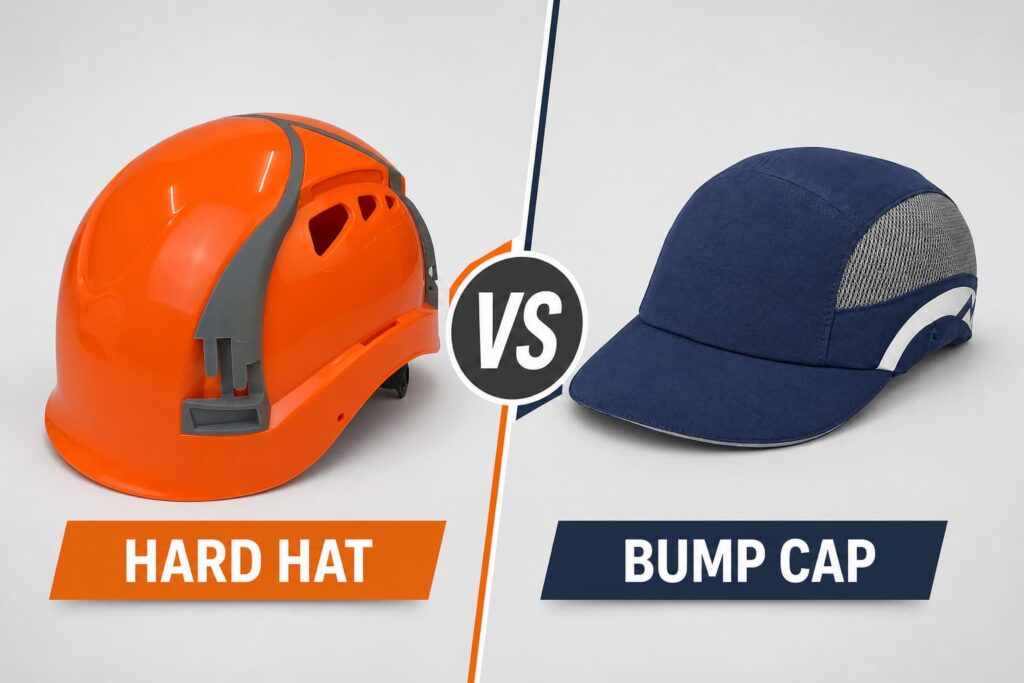
A bump cap and a hard hat can both reduce head injuries, but they are designed for different hazards. Choosing between them starts with one practical question: is the worker likely to strike a fixed object, or could an object strike the worker?
This distinction matters in warehouses, automotive plants, maintenance areas, assembly lines, construction sites, and many other workplaces. A lightweight bump cap may improve comfort in a low-clearance area, but it cannot replace a hard hat where falling or flying objects are present.
HBC has reviewed projects where a buyer initially wanted one type of head protection for an entire facility, only to discover that separate work zones required different solutions. This guide compares bump caps and hard hats, explains their standards and limitations, and shows how real working conditions should influence the final selection.
Bump Cap vs Hard Hat: The Short Answer
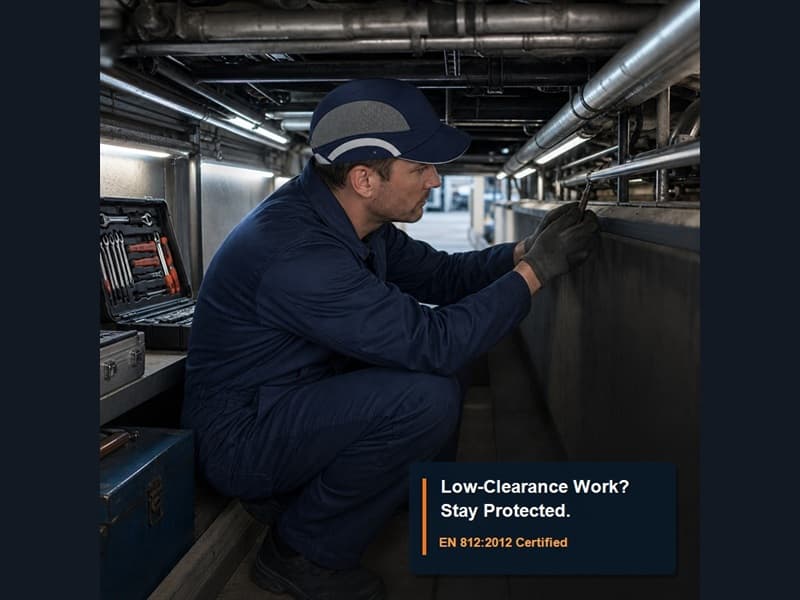
Choose a bump cap when the identified hazard is the wearer accidentally striking a hard, stationary object, such as a low pipe, shelf, vehicle body, or machine frame.
Choose an appropriately rated hard hat when workers may be exposed to falling objects, flying fragments, penetration, moving or suspended loads, or electrical hazards. The product must match the workplace risk assessment and the applicable market requirements.
| Comparison | Bump Cap | Hard Hat |
|---|---|---|
| Main impact source | Wearer strikes a stationary object | An object strikes the wearer |
| Typical hazards | Low pipes, beams, shelves, vehicle structures | Falling tools, materials, debris, flying objects |
| Typical construction | Fabric cap, protective insert, cushioning | Rigid shell, suspension system, shell-to-head clearance |
| Electrical protection | Normally none | Available only in appropriately rated models |
| Common European standard | EN 812 | EN 397 |
| Common US standard | ANSI/ISEA 100 | ANSI/ISEA Z89.1 |
| Typical working areas | Maintenance, assembly, food processing, vehicle repair | Construction, utilities, mining, high-bay warehouses |
| Can it replace the other? | No, not where hard-hat protection is required | May provide more protection than needed for some low-risk tasks, but hazard protection comes first |
Two Different Impact Scenarios
1. The Worker Hits a Fixed Object
A mechanic may raise their head into the underside of a vehicle. An assembly worker may move beneath a fixed frame. A technician may contact a low pipe while inspecting equipment.
These are worker-generated impacts. Where no falling-object, flying-object, suspended-load, or electrical hazard exists, an industrial bump cap may be suitable.
2. An Object Hits the Worker
A tool may fall from a platform, stock may drop from high racking, or debris may be produced by work taking place above an employee. These risks require industrial head protection selected for the expected impact and any additional hazards.
OSHA requires protective helmets where employees may be exposed to head injuries from impact, falling or flying objects, or electrical shock and burns. See OSHA 29 CFR 1926.100.
What Is an Industrial Bump Cap?
An industrial bump cap normally combines a fabric outer cap, an internal protective shell, and cushioning around the head. Its low-profile appearance and lighter construction can make it easier to wear for a full shift in confined or low-clearance areas.
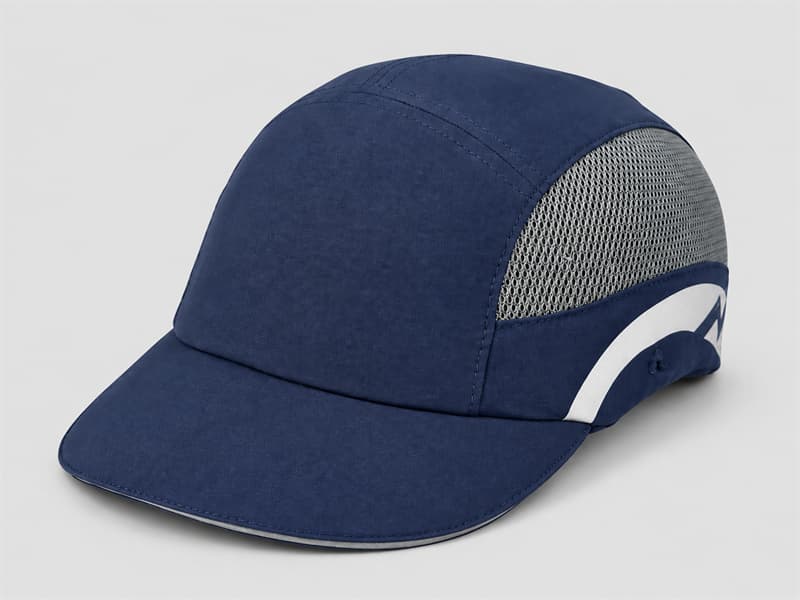
Industrial bump caps are commonly used by:
- Automotive production and repair workers
- Aircraft and machinery maintenance technicians
- Warehouse employees in selected low-clearance zones
- Food-processing and packaging workers
- Assembly-line employees
- Service technicians working around fixed equipment
The UK Health and Safety Executive explains that bump caps protect against bumping the head and scalping, but do not offer adequate protection against falling objects or moving and suspended loads. See the HSE personal protective equipment guidance.
What Does EN 812 Mean?
EN 812 covers industrial bump caps intended to reduce injuries caused when the wearer’s head strikes a hard, stationary object. It does not turn a bump cap into an industrial safety helmet.
In the United States, ANSI/ISEA 100-2024 establishes voluntary performance, testing, and labeling requirements for industrial bump caps and bump-cap inserts. Read the ISEA overview of ANSI/ISEA 100-2024.
HBC does not currently claim that the SF-71 complies with ANSI/ISEA 100-2024 based on the evidence reviewed for this article. For US projects, buyers should state which documents and standards they require before ordering.
SF-71 Bump Cap: Verified Product Example
The SF-71 provides a useful example of an EN 812 industrial bump cap. HBC’s reviewed documentation identifies the following configuration:
| Standard | EN 812:2012 industrial bump cap |
|---|---|
| PPE category | Category II |
| Certificate | EU type-examination certificate CE-PC-251212-694-01-9A |
| Certificate body | CCQS Certification Services Limited, notified body 2834 |
| Certificate period | January 29, 2026 to January 28, 2031, subject to status verification before shipment |
| Size | 53–63 cm |
| Fabric cover | Nylon and polyester |
| Comfort layer | Fabric and foam padding |
| Cushioning | EPS cushioning pad |
| Protective insert | HDPE inner shell |
| Ventilation | Mesh side panels and visible airflow openings; no quantified airflow claim |
| Weight | Approximately 150 g based on a measured sample; one sample measured about 151 g |
The measured weight should not be treated as a guaranteed production specification or tolerance. Buyers who need a contractual weight limit should confirm the final approved sample and production specification with HBC.
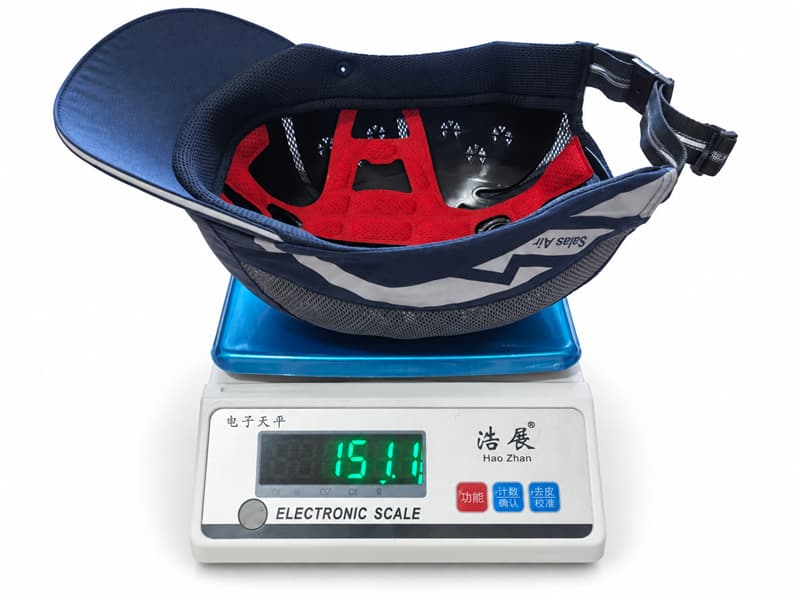
The current reviewed files confirm a navy-and-gray sample. Other colors, fabrics, logo methods, minimum order quantities, and sample policies should be confirmed before quotation because they are not established by the EN 812 certificate alone.
What Is a Hard Hat?
A hard hat uses a rigid outer shell and an internal suspension system to reduce the force transmitted to the wearer. The space between the shell and the head is part of the protective design.
Hard hats are appropriate for more serious industrial hazards, including falling objects, flying fragments, penetration, and, when the model carries the correct electrical classification, exposure to electrical conductors.
Under ANSI/ISEA Z89.1, Type I helmets address impacts to the top of the head, while Type II helmets address impacts to the top and sides. Electrical classifications are separate: Class E and Class G provide different levels of tested electrical performance, while Class C provides no electrical protection.
SF-08C-02 Safety Helmet: Comparison Example
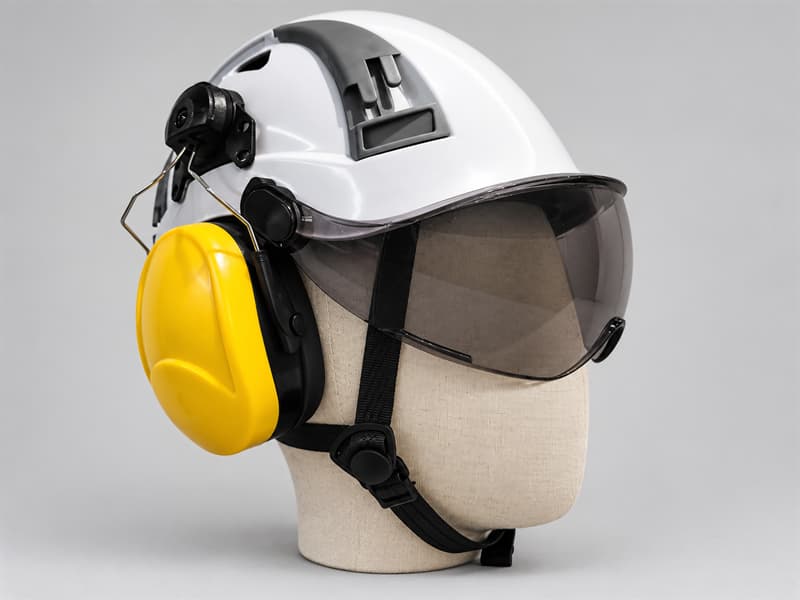
For comparison, the SF-08C-02 is listed with an ABS shell, EPS liner, and a four-point chin strap with PU chin cup. The manufacturer presents this model for work at height and gives a 53–63 cm head-size range. Its product page lists ANSI/ISEA Z89.1 Type II, Class C and EN 12492:2012; buyers should confirm the applicable certificates, test reports, markings, and exact supplied configuration with HBC.
- ANSI listing: Type II, Class C under ANSI/ISEA Z89.1; confirm the current test report and finished-product marking.
- European listing: EN 12492:2012; request the certificate and check that it covers the ordered configuration.
- Construction: ABS outer shell and EPS inner liner.
- Fit and retention: 53–63 cm listed head size; four-point chin strap with PU chin cup.
- Electrical class: Class C does not provide electrical protection; select a suitably rated helmet where electrical hazards exist.
The SF-08C-02 and SF-71 address different hazards. The former is a safety helmet whose manufacturer lists Type II, Class C and EN 12492:2012 for the specified model; the latter is an EN 812 industrial bump cap for contact with fixed objects. Confirm the SF-08C-02 documentation and the final configuration before selecting it for a worksite.
Field Experience: One Warehouse Needed Both
A large 3PL and e-commerce fulfillment center in Mexico initially asked HBC about lightweight EN 812 bump caps. The purchasing team wanted a product that looked like a baseball cap, offered mesh ventilation, and was more likely to be worn throughout the shift.
Further questions revealed that the facility included 12-meter storage racks, reach-truck traffic, elevated order-picking work, overhead sorting equipment, and a steel-structure expansion area. Those conditions introduced hazards that could not be addressed by a bump cap alone.
The solution was not to choose one product for the entire building. Low-clearance areas without falling-object hazards could use bump caps, while high-bay racking, elevated equipment, forklift routes, and overhead construction areas required appropriately selected industrial head protection.
This case demonstrates why an industry name such as “warehouse” is not enough to select PPE. Buyers need to examine each task and zone.
Field Insight: Peak Length Matters in Vehicle and Confined-Space Work
Automotive production lines, underbody maintenance teams, and confined machinery-assembly buyers often pay close attention to peak length. In some bulk inquiries, buyers request a micro or short peak of approximately 1–2.5 cm because a longer peak can restrict upward vision or contact nearby equipment.
This does not mean every product marketed as a “short-peak bump cap” has the same dimensions. Buyers should request an actual measurement from the cap body connection point to the front edge of the peak and approve a physical sample before placing a bulk order.
The SF-71 shown in this article has a curved peak, but the available evidence does not verify that it falls within the 1–2.5 cm micro-peak range. HBC therefore does not present it as the solution to that specific requirement without further measurement.
How to Choose Between a Bump Cap and a Hard Hat
- Identify the impact source. Determine whether the wearer may hit a fixed object or whether an object could strike the wearer.
- Check for overhead hazards. Include tools, stock, conveyors, suspended loads, construction work, and employees working above others.
- Assess impact direction. A hard-hat selection may need to account for top and side impacts.
- Check electrical exposure. Do not use a bump cap or Class C hard hat as electrical protection.
- Review fit and retention. Consider working position, bending, climbing, head movement, size range, and chin-strap requirements.
- Evaluate comfort after protection. Compare weight, suspension, sweat management, ventilation, and wearing time only after selecting the correct protection category.
- Verify the exact product evidence. Match the model, standard edition, certificate, report, materials, colors, accessories, and product markings.
Common Purchasing Mistakes
- Choosing a bump cap because it is lighter without completing a hazard assessment
- Assuming EN 812 provides the same protection as EN 397
- Using a bump cap beneath high storage racks without evaluating falling-stock risks
- Treating a test report as proof that every color, accessory, or production configuration is certified
- Assuming “short peak” is a standardized dimension
- Using a product photograph as proof of a standard or electrical class
- Adding holes or unapproved accessories to improve ventilation
- Failing to confirm certificate status and product markings before shipment
Frequently Asked Questions
Can a bump cap replace a hard hat?
No. A bump cap should not replace a hard hat where falling objects, flying objects, penetration, moving loads, electrical exposure, or workplace rules require industrial protective headwear.
Is a bump cap suitable for a warehouse?
It may be suitable in selected warehouse zones where the only identified hazard is contact with fixed objects. High racking, forklifts, overhead conveyors, falling stock, and construction activity may require hard-hat protection.
Is EN 812 the same as EN 397?
No. EN 812 applies to industrial bump caps, while EN 397 applies to industrial protective helmets. The products address different hazard levels and cannot be substituted solely because they both protect the head.
Does SF-71 meet ANSI/ISEA 100-2024?
HBC does not currently make that claim based on the reviewed evidence. The available documentation supports EN 812:2012 for the specified SF-71 configuration.
Is a lighter product always better?
No. Lower weight can improve comfort, but it cannot compensate for selecting the wrong protection category. Hazard suitability comes before weight, ventilation, or appearance.
How should buyers specify peak length?
State the required measurement in millimeters or centimeters, define where the measurement starts and ends, and request a ruler photograph or approved physical sample. Do not rely only on “short,” “micro,” or “standard” peak descriptions.
Match the Product to the Hazard
A bump cap is a practical solution when workers face fixed-object contact in low-clearance areas and no higher-level head hazard is present. A hard hat is the correct starting point when objects may fall, fly, penetrate, or create an electrical risk.
Before requesting a quotation, document the work task, impact source, overhead hazards, electrical exposure, wearing time, required peak length, size range, accessories, destination market, and required certification documents.
For a broader comparison that also covers modern safety helmets, read Bump Cap vs Hard Hat vs Safety Helmet: What’s the Difference?
To request a product-selection review, send HBC your application, destination market, required standards, target quantity, peak-length requirement, and any logo or packaging needs. HBC will confirm which specifications and documents are available for the proposed configuration.