
If a hard hat is marked Class E, Class G or Class C, the letter describes its electrical performance. It does not tell you whether the helmet protects only the top of the head or also addresses lateral impact. That separate question is covered by the helmet’s Type designation.
Quick answer: Class E is tested to withstand 20,000 volts, Class G is tested at 2,200 volts, and Class C provides no electrical protection. These are controlled test classifications—not safe working-voltage guarantees. OSHA requires employers to select head protection for the hazards identified at the workplace, including electrical contact hazards where applicable.
Last technically reviewed: November 10, 2026. This guide is for procurement and product-selection support; it does not replace a site-specific electrical risk assessment or safe-work procedure.
What Do Hard Hat Classes Mean?
ANSI/ISEA Z89.1 classifies industrial head protection by both impact performance and electrical insulation. The current ANSI/ISEA Z89.1-2026 standard retains the familiar E, G and C electrical classes. OSHA’s general-industry rule, 29 CFR 1910.135, requires suitable head protection where falling-object or electrical-contact hazards exist and lists incorporated ANSI editions or an equally effective alternative.
| Electrical class | Test designation | Typical selection context | Ventilation |
|---|---|---|---|
| Class E | Tested to withstand 20,000 V | Higher-voltage electrical exposure identified by the hazard assessment | Normally non-vented |
| Class G | Tested at 2,200 V | General service with limited electrical-contact exposure | Normally non-vented |
| Class C | No electrical protection | Impact protection where electrical insulation is not required | Often available with vents |
Class E: Electrical
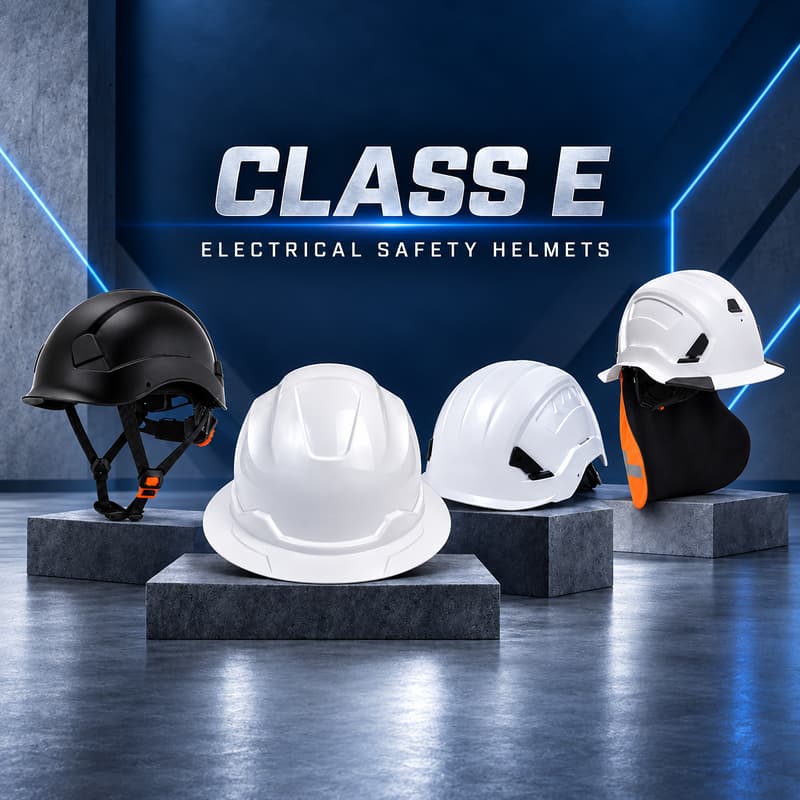
A Class E hard hat is designed to reduce the danger of contact with higher-voltage conductors and is tested to withstand 20,000 volts under the standard’s controlled test conditions. It is commonly specified for electrical utility, substation, power-distribution and industrial maintenance work when the site assessment identifies an electrical head-contact hazard.
Class E does not make the helmet an all-purpose insulating device or identify impact direction. Check the Type separately, and verify that the complete marked configuration matches the supporting documents.
Class G: General
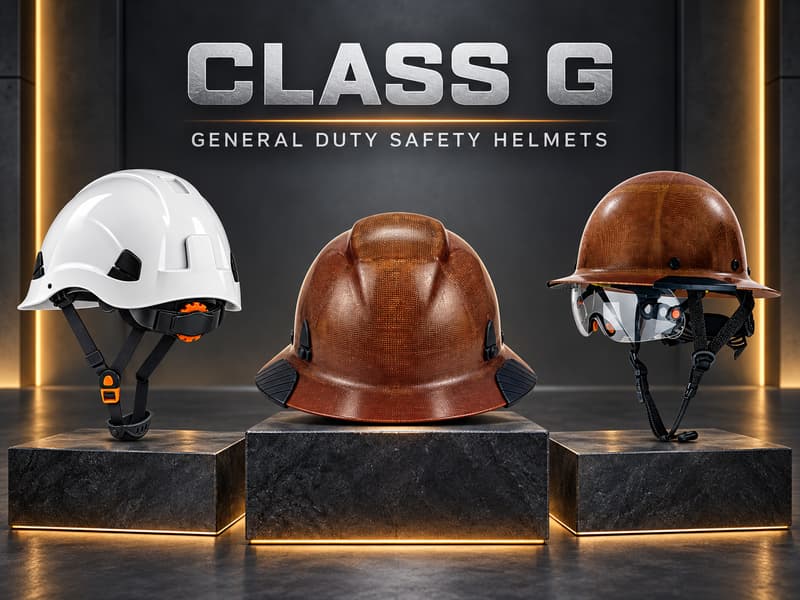
A Class G hard hat is intended to reduce the danger of contact with lower-voltage conductors and is tested at 2,200 volts. It is not interchangeable with Class E when the specification or risk assessment calls for the higher electrical class.
Class C: Conductive
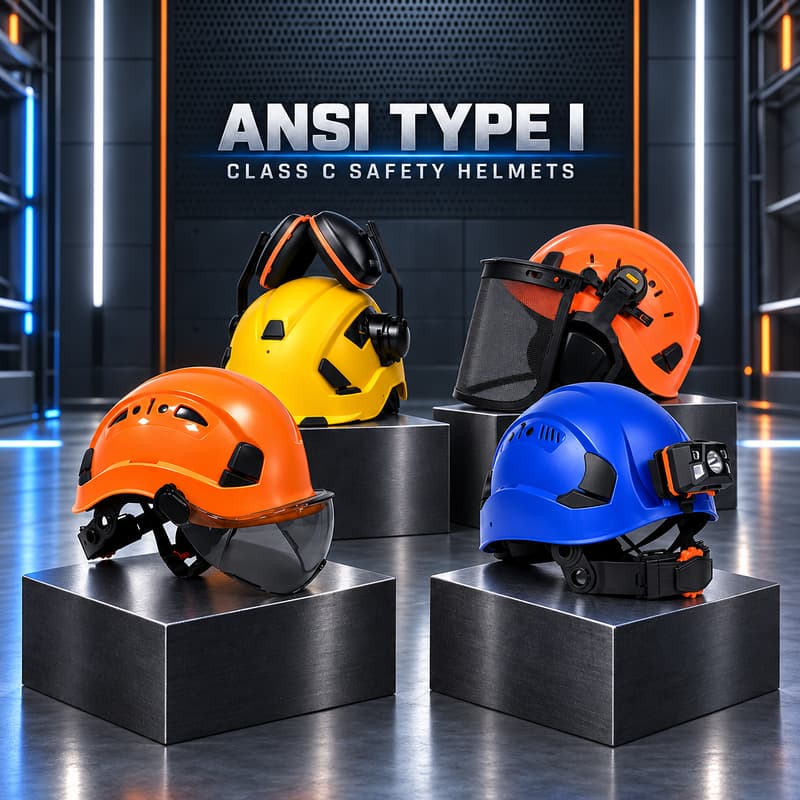
A Class C hard hat provides no electrical protection. The “C” is not a lower level of electrical insulation. Modern Class C products may use plastic shells and may offer useful impact, accessory or ventilation features, but buyers must not infer electrical protection from the material or appearance.
Class C designs are often selected where ventilation is valuable and electrical contact is not an identified hazard. They still need the correct impact Type and applicable standard.
Proof-Test Voltage Is Not a Safe Working Voltage
The most dangerous misunderstanding in this category is treating “20,000 V” or “2,200 V” as a voltage at which a worker may safely contact an energized conductor. That is not what the marking means.
The values describe laboratory proof tests under defined conditions. As 3M explains, the test voltages are not intended to indicate the voltage at which the helmet protects the wearer. Moisture, contamination, damage, aging, accessories and other possible current paths can change real-world exposure.
Procurement rule: Never convert the Class E 20,000 V proof-test value—or the Class G 2,200 V value—into an allowable contact voltage, approach distance or energized-work authorization.
A hard hat is one component of an electrical safety program. De-energization, lockout/tagout, approach boundaries, qualified-person requirements and task-appropriate insulating and arc-rated PPE must be determined under the applicable site rules and regulations.
Can a Class E Hard Hat Have Ventilation Holes?
For practical purchasing, treat ventilation holes and electrical insulation as conflicting requirements. Openings interrupt the continuous shell barrier and can create pathways that are incompatible with the helmet’s intended electrical performance. OSHA’s Head Protection: Safety Helmets in the Workplace bulletin states that vented hard hats or safety helmets cannot be used for electrical work.
Most vented models are therefore marked Class C. A buyer searching for a “vented electrical hard hat” should not rely on that phrase in a listing. Check the permanent Class marking on the exact helmet and confirm the manufacturer’s instructions and test documents. Never drill holes in a non-vented shell to improve airflow; doing so changes the tested construction and may also weaken impact and penetration performance.
Heat stress still needs controls such as shade, work/rest scheduling, hydration, approved cooling accessories or different helmet allocation by job—not unverified shell vents.
Field Experience—The “Class E Plus Large Vents” Conflict
In one Saudi energy-project inquiry, the buyer initially requested one helmet for the entire workforce: Class E electrical protection, large ventilation openings and comfortable performance in high ambient temperatures. Each requirement sounded reasonable in isolation, but together they created a specification conflict.
Instead of quoting a product immediately, the HBC team asked which workers could be near exposed conductors and which workers were performing civil construction, steel-support installation and other non-electrical tasks. The project did not actually have one exposure profile; it had at least two.
- Electrical and commissioning teams: non-vented helmets in the required electrical class, with only manufacturer-approved accessories.
- Civil and support-installation teams: vented Class C models where the site hazard assessment confirmed that electrical insulation was not required.
The site could then reserve one helmet color for the electrical configuration and a clearly contrasting color for the vented civil configuration. Color made supervision and toolbox checks faster, but it was only a management aid: the shell marking remained the proof of Type and Class. The same color should never be assumed to represent the same rating across projects or suppliers.
A contradictory product request may really be a workforce-allocation problem. Ask who performs each task, whether conductors could contact the head and what heat controls are available. Two controlled helmet groups may be safer than one compromised specification.
How to Verify a Hard Hat’s Rating
A web-page claim is not final compliance evidence. Before approving a bulk order, use these checks.
- Inspect the permanent shell marking. Confirm the manufacturer, model or identifying designation, ANSI/ISEA Z89.1 reference, Type and electrical Class. Optional performance markings should also match the purchase requirement.
- Separate Type from Class. Type addresses impact direction; Class addresses electrical performance. Both must match the hazard assessment.
- Check the standard edition. ANSI/ISEA Z89.1-2026 is the current industry edition as of this review, while OSHA’s regulation lists earlier incorporated editions or an equally effective alternative. State the edition required by the project, authority or customer instead of writing only “ANSI.”
- Read the manufacturing date code. Confirm how the code is interpreted and evaluate storage history, service-life guidance and replacement policy.
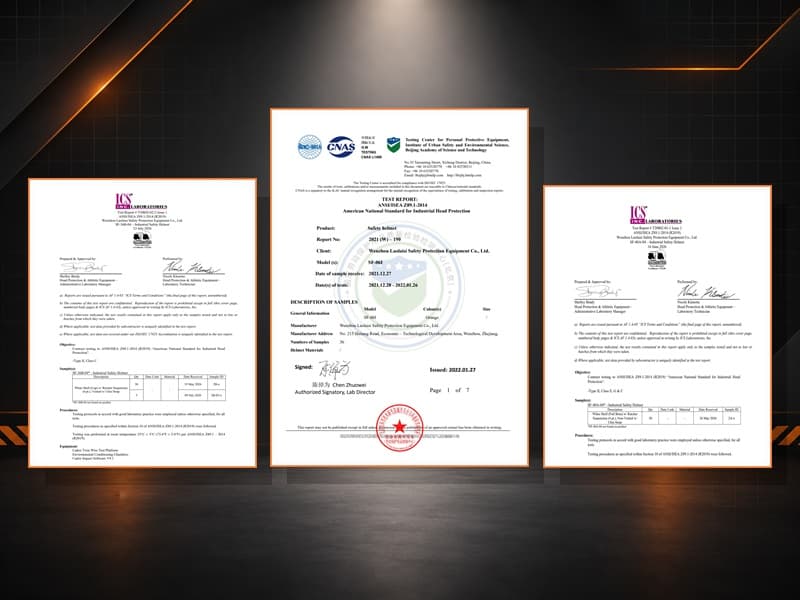
- Review the test report. The report should identify the tested model, construction, class, type and relevant test clauses—not merely show a generic family name.
- Match certificates and documents to the product. Model numbers, shell design, suspension, accessories, factory and standard edition should be consistent. Ask about any difference before shipment.
- Verify the delivered configuration. Compare carton labels, helmet markings and approved samples with the purchase specification during incoming inspection.
Be cautious with phrases such as “OSHA approved” or “ANSI approved.” ISEA notes that these terms are misleading: OSHA sets workplace requirements, while manufacturers demonstrate conformance to product standards through required markings, documentation and testing processes.
Common Purchasing Mistakes
- Treating Class C as low-level electrical protection. It provides no electrical protection.
- Checking only the supplier’s web page. The delivered helmet’s permanent marking and matching documents are essential.
- Reading test voltage as safe contact voltage. The 20,000 V and 2,200 V values are controlled proof-test designations.
- Drilling ventilation holes. Any unapproved shell modification can invalidate the tested configuration and compromise protection.
- Using unapproved accessories. Lights, clips, face shields, hearing protection, stickers or replacement suspensions can affect performance; use only combinations accepted by the manufacturer.
- Using color as proof of class. Color coding helps administration, but the shell marking determines the rating.
- Ignoring contamination and damage. Cracks, deep scratches, chemicals, paint, heat and UV exposure can affect performance. Follow inspection and retirement instructions.
Class E vs Class G Hard Hat: A Buyer’s Decision Sequence
- Identify whether exposed electrical conductors could contact the worker’s head.
- Record the task, electrical system, applicable rules and site-required Class.
- Choose impact Type separately based on top, side and off-center hazards.
- Decide whether ventilation is permissible; do not trade away electrical protection for comfort.
- Confirm temperature range, fit, retention and approved accessory needs.
- Require product markings and model-specific supporting documents before approval.
- Use training and, where helpful, site-specific color coding to prevent cross-use.
Questions Buyers Often Ask
Is a Class E hard hat safe at 20,000 volts?
No safe working voltage should be inferred from the 20,000 V test designation. Class E is designed to reduce the danger of electrical contact within its tested scope; it does not authorize deliberate contact with an energized conductor.
Is Class G the same as Class E?
No. Class G is tested at 2,200 V, while Class E is tested to withstand 20,000 V. Select the class specified by the hazard assessment and project requirements.
Can a vented hard hat be Class E?
Do not assume so. OSHA guidance states that vented hard hats and safety helmets cannot be used for electrical work. Verify the permanent class marking on the exact model; most vented designs are Class C.
Does Class C mean the hard hat fails impact tests?
No. Class C refers to the absence of electrical protection. Impact performance is identified separately by Type and the applicable standard markings.
Send HBC the Job Information Before Selecting a Helmet
For a useful recommendation, send HBC three items: the workforce role breakdown, the electrical hazards for each role, and the expected ambient temperature. Also include impact direction, work-at-height needs, required accessories, destination market and the standard edition stated in the tender.
Discuss Your Hard Hat Requirements with HBC
Jiangsu Huibaicheng Group Co., Ltd. (HBC) supports global B2B buyers with head-protection product selection, document matching and OEM/ODM discussions. Final PPE selection remains subject to the employer’s hazard assessment, applicable regulations and approval of the exact production configuration.